Edplay overview
What operations leaders are telling us, and how Edplay answers it
Operations leaders are telling us the same thing: knowledge is leaving their plants and competence can't be proven. This overview shows how Edplay closes that gap, how we measure it, and where we're heading.
Question 01
How does Edplay become part of daily work on the plant floor?
Question 02
How do we prove competence and impact, beyond completions?
Question 03
What does the raise fund, and which milestones does it reach?
Manufacturing only. Product, marketing, partnerships and trade shows point at one industry.
Operations is the buyer. Operations, maintenance and reliability leaders describe the problem most clearly.
Two offers. Verified training from about $8,000 a year. Workforce intelligence with knowledge capture from $60,000 a year.
In their words
The problem, from the plant floor
“We were losing a lot of people for retirement... there's a lot of knowledge that existing ones have that would easily be lost... Some of these people have done 50 years of working there.”
Operations leader, Orbia
“We're typically too busy to fill out the documentation... but then we lose visibility of that as soon as they forget. Or they leave.”
Reliability lead, Phillips 66
“If we learn something here, how do we ensure that everybody in Puerto Rico learns the same thing quickly?”
Operations Strategy Lead, CooperVision
“We were even talking about putting GoPros on some of our core operators... but the problem we had then is how do we then do something with that data?”
Operations leader, Orbia
Question 1
How Edplay becomes embedded in operational workflows
It starts from a measured gap and ends with proof the gap has closed.
01
Find the gap
By team and machine, from existing systems.
02
Skill or knowledge?
Missing skill, or no approved knowledge.
03
Source it
SOPs first, expert capture where needed.
04
Verify it
Checked against approved sources, signed off.
05
Deliver it
At the machine, in the worker's language.
06
Retest, record
Competence recorded against each skill.
What changes for each role
Operator
Finds the approved fix at the machine
SOP, video or past repair for that equipment, in their language.
Supervisor
Knows who can run each machine, every shift
Qualification and sign-off by machine, site and shift.
Operations leader
Sees which gaps cost the most
Shared gaps across teams, tracked against operations KPIs.
Light to run: frontline staff spend minutes a month, supervisors review and approve, IT is needed only at kick-off.
Question 2
How we measure outcomes
Completion is not competence. We measure in two layers, with success measures agreed with operations before a pilot starts.
Level 1
Read the approved procedure
Level 2
Completed verified training and assessment
Level 3
Observed doing the task
“Today it says this person has demonstrated competence once they've signed to say they've read it... there are 3 dimensions to this now. You need to read the procedure. You need to have watched the video and you need to have completed the Q&A.”
Operations Strategy Lead, CooperVision
Competence on the plant's own terms
Each customer defines what proficiency means for their business.
Start from ILUO, four levels, competent / not yet, or qualified / trainee / trainer, or build your own. Each skill's sign-off ties to that scale: which SOPs must be read, which training passed, and who signs off at work.
Leading indicators, inside the pilot
Gap closure rate · Time to competence · Retest pass rate · Reviewer edit rate
Operations KPIs plants already track
Non-conformances · Scrap · Downtime · First-pass yield
Competence scales
Start from a common scale and adjust it, or build your own.
ILUO
I: in training → L: works under supervision → U: works alone to standard → O: can train others
Four levels
Level 1 → Level 2 → Level 3 → Level 4
Competent / not yet competent
Not yet competent → Competent
Qualified / not qualified
Not qualified → Trainee → Qualified → Trainer
Blank scale
Two levels to start from.
Pipeline
Six workforce intelligence opportunities
All six conversations took place between 1 and 16 October, each with the people who own operational performance or knowledge retention. Workforce intelligence starts at $60,000 a year and scales with sites, machines and hardware.
CooperVision
6 OctOperations Strategy Lead
Could use Edplay to evidence operator competence per machine and share what one site learns with the UK and Puerto Rico.
“We have to demonstrate that our operators are trained to operate these machines... that's pivotal to ensuring product quality, product performance, and factory performance.”
Next: proof of concept, then workforce intelligence across sites.
Phillips 66
16 OctContinuous improvement and reliability
Could use Edplay to capture as-found conditions and repairs into SAP work-order closure across around 10 refining sites.
“So when we work this piece of equipment, you know, in 2 years or 5 years from now, we know what was found last time... and are we seeing repeat failures?”
Next: joint call with L&D and Maintenance.
Orbia
16 OctOperations leader, UK
Could use Edplay to keep the knowledge of long-serving operators across two UK high-hazard sites.
“I can almost see that very soon you'll be able to do things like hazard spotting and almost create job safety analysis.”
Next: knowledge-capture demo for UK operations.
Parts Town Unlimited
12 OctTraining and compliance, 4 divisions
Could use Edplay to set one standard for compliance, onboarding and site processes across four divisions.
“I love the idea of being able to have someone wear a camera... so it's not always the hands-on training where processes might get skipped.”
Next: live build session, 22 October.
Leverage Premier
1 OctHR, training and QA
Could use Edplay to turn field audit failures into targeted training for 250-300 field staff.
“What are the top 5 reasons in the last 6 months for our audit results failures?... We know what we got to hone in on in our tailgate.”
Next: proof of concept on one region's audit data.
Abel Womack
14 OctLearning and knowledge lead
Could use Edplay to record experienced staff and turn it into SOPs ahead of a wave of retirements.
“Isn't part of SOP around recording? I mean, if you're recording processes and you're using that to create the SOPs, right?”
Next: follow-up, 23 October.
Defensibility and moat
The models are interchangeable. The evidence is ours.
Generation is never fully deterministic, so we build everything around it to make the outcome as close to deterministic as possible, and to compound with every deployment.
The judgment layer
Manufacturing rules we own
Sources scored before anything is generated, every claim cited, unsupported content rejected, and a reviewer signs off. Built for technical diagrams, equipment and safety-critical steps.
What compounds
A record no one else sees
Reviewer decisions, approved knowledge linked to each machine, and retest results. It grows inside each customer, with their data kept isolated.
Better AI helps us
Verification gets more valuable
As generation gets cheaper, unverified content floods every company. Verified training and proof of competence become scarcer, and worth more.
Positioning
Gap-first, not camera-first
Camera-first tools verify a task was done. Edplay starts from the measured gap and the plant's approved sources, and proves the gap has closed.
Our moat, and how it builds
1 · Switching costs
Each plant's skills map, sign-off history and machine-linked knowledge live in Edplay. Leaving means rebuilding and re-verifying it.
2 · The outcome record
Which training closed which gap, on which task, in how many retests. Model vendors never see the retest; skills platforms never deliver the fix.
3 · Distribution
Embedded as the engine that closes and verifies gaps for skills platforms, reaching their installed base.
Question 3
Our plan
$2.5M, planned to last 36 months without further funding (base case, financial model of September 2026).
$1M
ARR by month 12
50
Customers by month 12
$2M
ARR by month 18, Series A point
Month 13
$1M ARR in the downside case
| Scenario | Downside | Base | Upside |
|---|---|---|---|
| ARR, year 1 | $0.93M | $1.12M | $1.41M |
| ARR, year 2 | $2.35M | $2.99M | $3.98M |
| Lowest cash point | $433K | $752K | $1.04M |
What the raise funds
Two enterprise sales reps · technical customer success on site · two developers · the founder-led operations motion · trade shows released against pipeline results.
Unit economics
Workforce intelligence at about $65K ACV ($60K-$75K across scenarios).
Where Edplay is heading
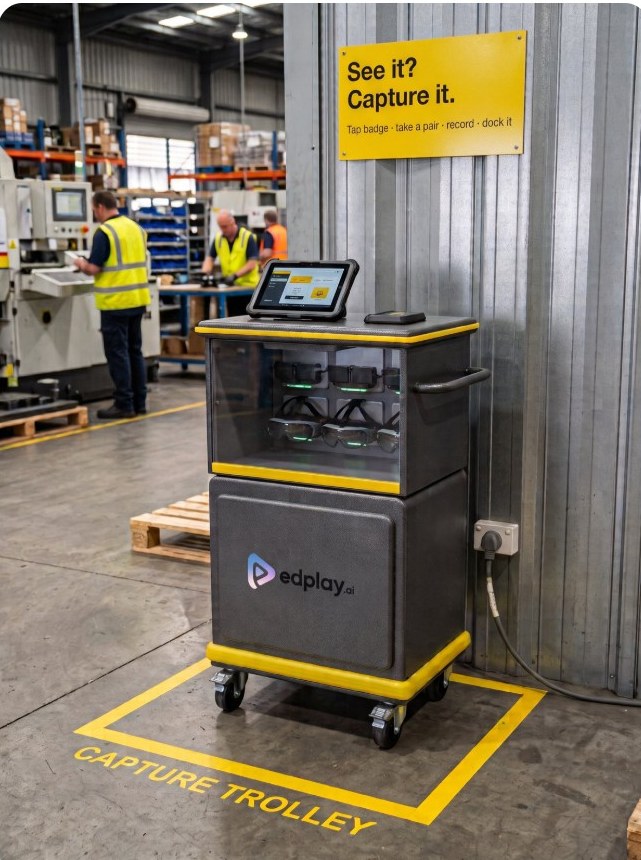
A capture point on every floor
Concept mock-ups of the on-site capture prototypes we are building towards, so recording expert work becomes as routine as picking up PPE.
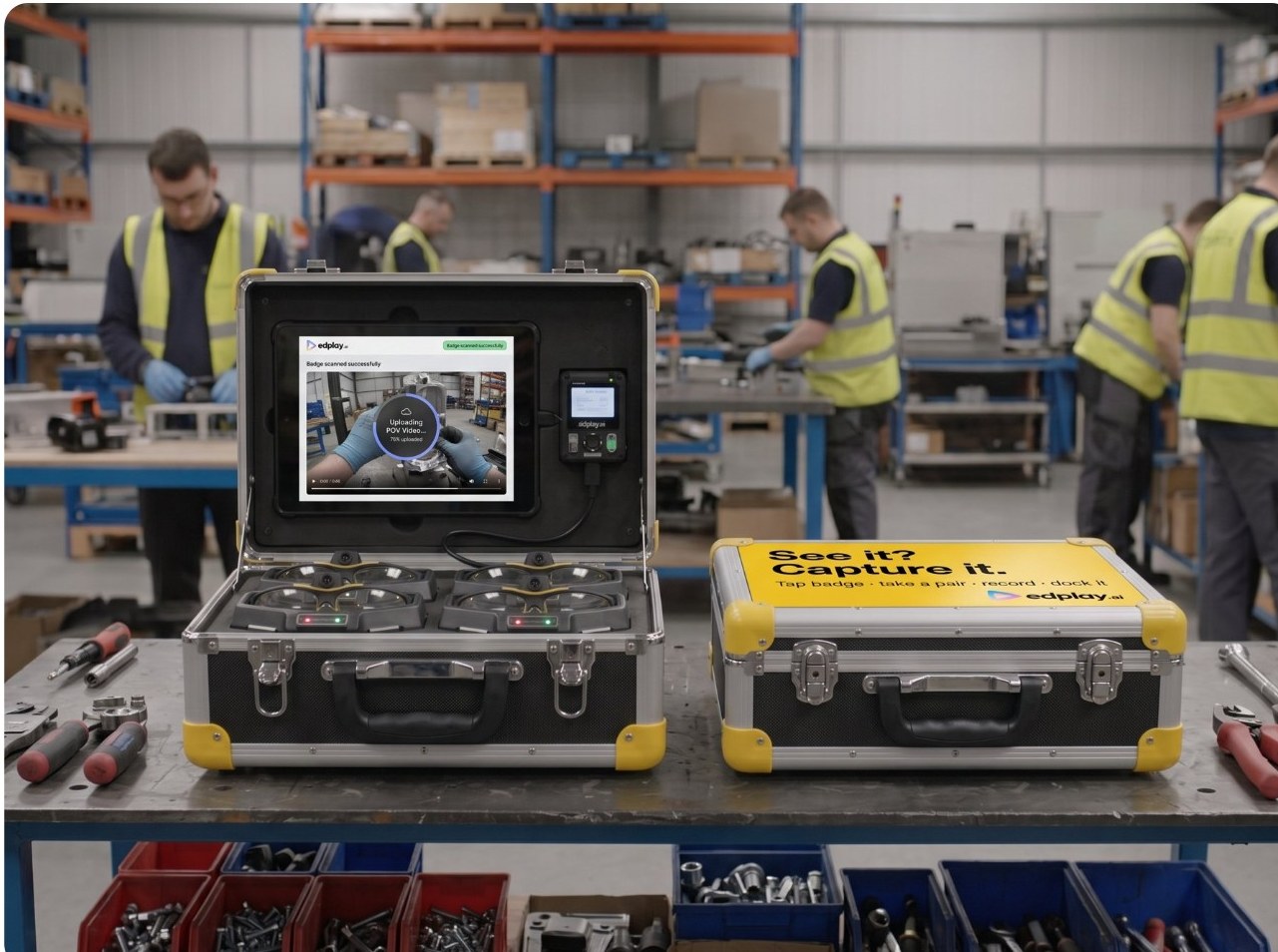
How it works on site
Docking uploads the recording, links it to the machine and creates a draft SOP for approval. Concept renders; hardware is in prototype. A phone route covers sites that allow phones.
Quotes are from discovery conversations and shared with permission. · edplay.ai